


Your brain compresses and recombines day‑residue into time‑compressed, looped activations that rehearse salient memories for consolidation, creativity, and threat‑detection. Hippocampo‑neocortical replay and synaptic downscaling prune noise while REM’s limbic surge and amygdala tagging crank up affect. Dreams are mosaics of fragments, not faithful replays, and nightmares reflect overamplified fear circuitry. You can boost recall and steer scenes with intentions, naps, journaling, lucid techniques — keep going to learn practical, testable steps plus neuroscience behind them.
Key Takeaways
- Your sleeping brain recombines compressed memory fragments into vivid, emotionally charged scenes to consolidate learning and rehearse responses.
- Limbic hyperactivity during REM amplifies salience and emotion, turning neutral elements into threatening or meaningful dream content.
- Nightmares reflect overactive threat-simulation and amygdala-driven consolidation, often flagging unresolved fear or trauma for further processing.
- Reduced prefrontal control allows creative recombination and problem solving, while lucidity techniques can regain control and steer dreams.
- Simple recall practices (pre-sleep intention, timely journaling, REM-timed wakings) measurably improve dream memory and insight.
How Dreams Are Built: The Neuroscience of Nighttime Storytelling
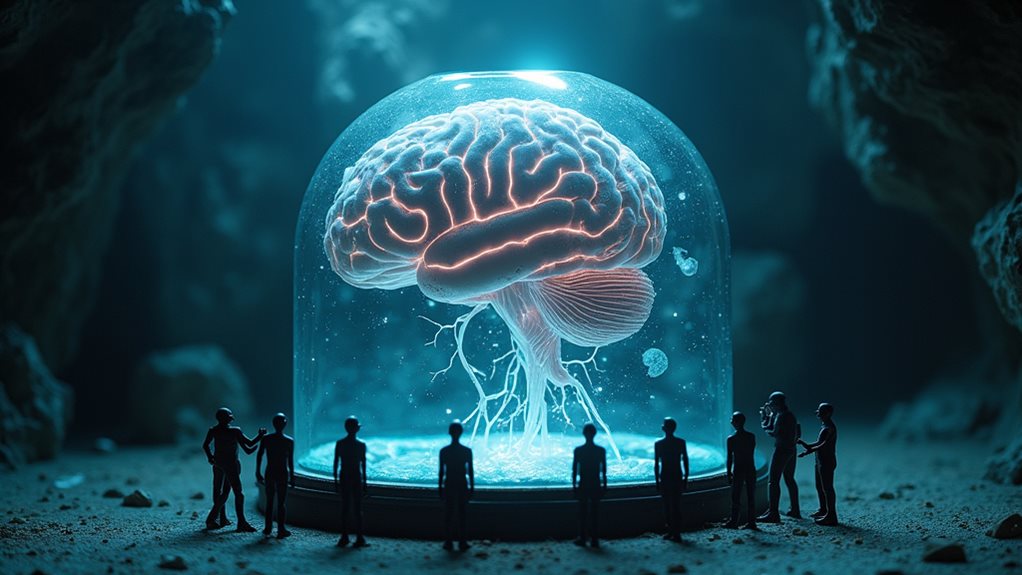
While you sleep, your brain stitches fragments of memory, emotion and sensation into cinematic narratives using well-mapped circuitry and neurochemistry.
While you sleep, your brain stitches memory, emotion and sensation into cinematic narratives with precise neurochemical choreography
You witness neural replay as sequences from waking experience fire in compressed loops, and hippocampal consolidation transfers episodic traces into cortex.
Synaptic homeostasis downscales noise, preserving salient connections while pruning excess.
Cortical coupling coordinates slow oscillations, spindles and ripples to time information flow.
You don’t get random chaos but a staged rehearsal: circuits rehearse, restructure and reallocate resources, producing vivid, sometimes bizarre plots.
It’s efficient, measurable engineering of subjective scenes, grounded in electrophysiology and computational principles and predictive models.
Day Residue and Memory Fragments: What Your Brain Recycles

You often carry wakeful images into sleep—sensory residues from your day show up as the raw pixels of nocturnal scenes.
Your brain preferentially reprocesses emotionally salient memories, actively recycling affect-laden traces to consolidate or re-evaluate them. The result is fragmented scene replay: stitched-together snapshots and mismatched contexts that your dreaming mind grafts into surreal narratives.
Lingering Wakeful Images
Because your brain keeps a short-list of recent inputs, you’re likely to find fragments of the day cropping up in dreams as compressed, recombined snapshots rather than faithful replays; research shows hippocampal replay and hippocampo‑neocortical consolidation preferentially sample recent, salient, or emotionally tagged memories, so those odd half-scenes and lingering images aren’t random noise but byproducts of memory-sorting algorithms at work.
You get sensory hangovers and image echoes: hippocampal replay stitches, as cortical networks associate.
These residual visuals guide integration during offline consolidation; they conserve cues, prioritize novelty, and enable completion.
Expect juxtapositions, not reruns.
- recent
- salient
- novel
- tagged
Emotional Memory Recycling
Those lingering sensory echoes don’t just float aimlessly — your brain selectively re-tags them with emotion during offline processing, so daytime feelings get recycled into the same memory-sorting pipeline that handles raw percepts.
You experience implicit sorting: hippocampal–amygdala interactions flag salient traces while cortex consolidates context.
During quiet states, low-frequency oscillations coordinate replay and prioritize emotionally tagged items, a mechanism supported by human imaging and rodent electrophysiology.
This affect tagging biases retention, shaping which fragments later influence mood and decision-making.
You don’t consciously edit this work; neurobiology trims, amplifies, and queues fragments for future relevance with efficient, mischievous, selectivity.
Fragmented Scene Replay
While sleep unfolds, hippocampal ensembles and distributed cortical circuits replay compressed snippets of the day’s scenes — not tidy movie re-runs but littered, time‑compressed fragments stitched together by sharp‑wave ripples, spindles, and slow oscillations.
You witness a sensory montage: faces, sounds, textures recombine with temporal dislocation, producing fragmentary rehearsal that prioritizes salient associations.
This offline sampling refines synaptic weights and extracts statistical structure.
Notice how the brain selects, fragments, and binds content points:
- salient cues
- contextual residues
- emotional tethers
- predictive snippets
You wake with stitched traces, not perfect copies.
Sleep-stage timing sharpens which fragments persist durably.
Emotion at Play: Why Feelings Amplify Dream Intensity

Emotion acts like a volume knob for your dreams, turning subjective salience into vivid, often bizarre narratives.
When you enter REM, limbic hyperactivity amplifies salience signals so memories and percepts get prioritized; you feel intensified joy, fear, or shame. Research links amygdala activation with dream intensity, and phenomena like mood contagion during sleep can bias dream social content.
Affect coloring alters the valence of neutral elements, making mundane objects feel threatening or comforting.
You should note this isn’t mystical; it’s predictable neurophysiology directing rehearsal and emotional processing while you snooze. Your sleeping brain prioritizes feelings over literal accuracy regularly.
Problem Solving and Creativity During Sleep

Because sleep relaxes your brain’s executive grip, it lets remote ideas collide and recombine, yielding genuine creative leaps and solved problems.
You can leverage incubation techniques and creative incubation by seeding a focused question before sleep, then trusting hypnagogic insights and subconscious problem solving to surface novel solutions.
Track prompts, dreams, and fragments for reproducible outcomes.
Try routines that balance intensity and relaxation.
Benefits include improved divergent thinking and memory consolidation.
This evidence-based approach preserves creativity while avoiding overtraining the system reliably.
- Seed a concise question
- Maintain a light sleep diary
- Use short naps strategically
- Note hypnagogic flashes immediately
Threat Simulation: Rehearsing Danger and Survival

You get more than creativity from your sleeping brain: dreams often run fast-paced rehearsals of danger that help you practice threat detection and response.
In REM you’ll replay ambiguous scenarios—chases, falls, social threats—activating amygdala-driven arousal and cortical patterning that refines threat rehearsal and neural circuits for rapid response.
Researchers interpret these episodes as survival simulations: low-risk practice for real-world contingencies, enhancing perceptual sensitivity and decision heuristics.
You won’t consciously memorize every outcome, but repeated simulated encounters bias attention and readiness.
Dreamed threats compress time, intensify emotion, and let you test strategies safely, training ground your brain runs during rest.
Lucid Dreams: When You Steer the Underground Plot

Once you recognize the dream state, lucid dreaming lets you steer the underground plot with measurable brain changes and reliable behavioral markers.
- mnemonic induction
- sensory cues
- sleep-timing protocols
- reality checks
You can cultivate lucid triggers to increase awareness; EEG and REM reports show prefrontal activation correlates with lucidity.
Intentional practice strengthens metacognition. Use habit-forming routines to signal dreaming and record outcomes for objective verification.
Benefits include rehearsal, creativity, and emotional regulation when applied safely.
Keep procedures replicable, monitor physiological markers, and iterate based on empirical feedback.
You should track frequency, duration, and control metrics regularly to refine technique periodically.
Nightmares and Their Function: When Rehearsal Goes Awry

Although dreams often serve as low-stakes rehearsal for emotional and social challenges, nightmares happen when that rehearsal hijacks systems meant to regulate affect and consolidate memory.
You experience intense, aversive simulations when threat-processing circuits and limbic activation amplify rather than contextualize fear, an adaptive evolutionary rehearsal gone extreme.
Neuroimaging links heightened amygdala activity and disrupted prefrontal control to nightmares, and sleep fragmentation suggests REM misfiring that preserves arousal.
Functionally, nightmares may flag unresolved trauma and overconsolidated fear memories, prompting waking reassessment.
You shouldn’t see them as meaningless noise; they’re noisy diagnostics from circuitry trying, clumsily, to keep you safe.
Practical Strategies to Nudge and Remember Your Dreams

If you want to remember more dreams, treat recall as a simple, testable protocol: set a concise pre-sleep intention, optimize sleep timing to hit late-night REM, and practice immediate reporting on wakening.
You’ll boost recall with consistent sleep journaling, gentle sensory priming, and awakening into calm arousal. Use targeted tweaks and measure results.
- Set brief intention nightly.
- Keep a bedside notebook for sleep journaling.
- Use mild sensory priming (soft scent or dim light).
- Wake during REM-rich windows and record immediately.
Repeat, quantify, adjust — that’s how you nudge dreaming reliably, and track progress weekly, objectively.
Frequently Asked Questions
Can Dreams Predict Future Events?
No, you can’t reliably predict the future with dreams; precognitive imagery appears anecdotal, while symbolic forecasting reflects memory, pattern detection and emotional salience — rigorous studies show correlation, not causation, despite intriguing, statistically rare coincidences.
Do Animals Dream About Human Owners?
Yes, scientific rigor meets affectionate memory: you’ll likely dream about your owner because animals’ REM activity reflects attachment bonds and sensory traces; researchers show neural replay uses scent cues and learned social associations during sleep.
Are Dreams Legally Admissible in Court?
No, courts generally reject dreams as direct evidence; you can’t submit them as reliable testimony because memory reliability is poor, so judges rely on corroboration and expert testimony to evaluate any dream-based claims or impressions.
No, you can’t literally share one identical dream; studies show only partial overlap. You can induce lucid synchronization via cues, producing shared symbolism and correlated imagery, so interpret overlap cautiously and curiously, with neuroscience evidence.
Do Artificial Intelligences Experience Dreaming?
Not really; you shouldn’t imagine AIs dreaming. You run lucid algorithms and simulate neural reveries during offline training, but you won’t access subjective qualia, it’s deterministic pattern replay and optimization, not inner experience or consciousness.
Conclusion
You know that sleep stitches neural patterns into vivid narratives, recycling day residues, amplifying affective salience, and running threat simulations—processes supported by hippocampal replay, limbic activation, and prefrontal modulation. You can cultivate lucidity, enhance recall, and harness nocturnal creativity with validated techniques such as reality checks, sleep hygiene, and targeted memory reactivation. Treat your dreams like a subterranean lab: tend experiments gently, record outcomes, and iterate—your sleeping brain will reward curiosity with richer, functional nights.